

I wanted to learn dozens of subjects; Anki eventually became very central in my life. After 9 years, over 1M reviews1 and 17k handwritten notes tagged as STEM (almost all now suspended), I find myself frustrated and sometimes wondering what it was all for.
This whole post is me complaining about the hardships of learning, the limitations of the systems meant to make learning easier, and the naivete of embarking on decades-long studying projects.
Sharing this feels self-indulgent, so I apologize. After clicking publish I promise to wash my hands twice in a row and then get to work building solutions for the problems I faced and that I will describe. The impatient reader can navigate to ritornello.dev to see a few Anki decks and add-ons that I created. However, my wackiest experiments haven’t made their way there yet and those are what could possibly advance the state-of-the-art. There is so much to try, and AI makes many new things possible.
I will start venting now.
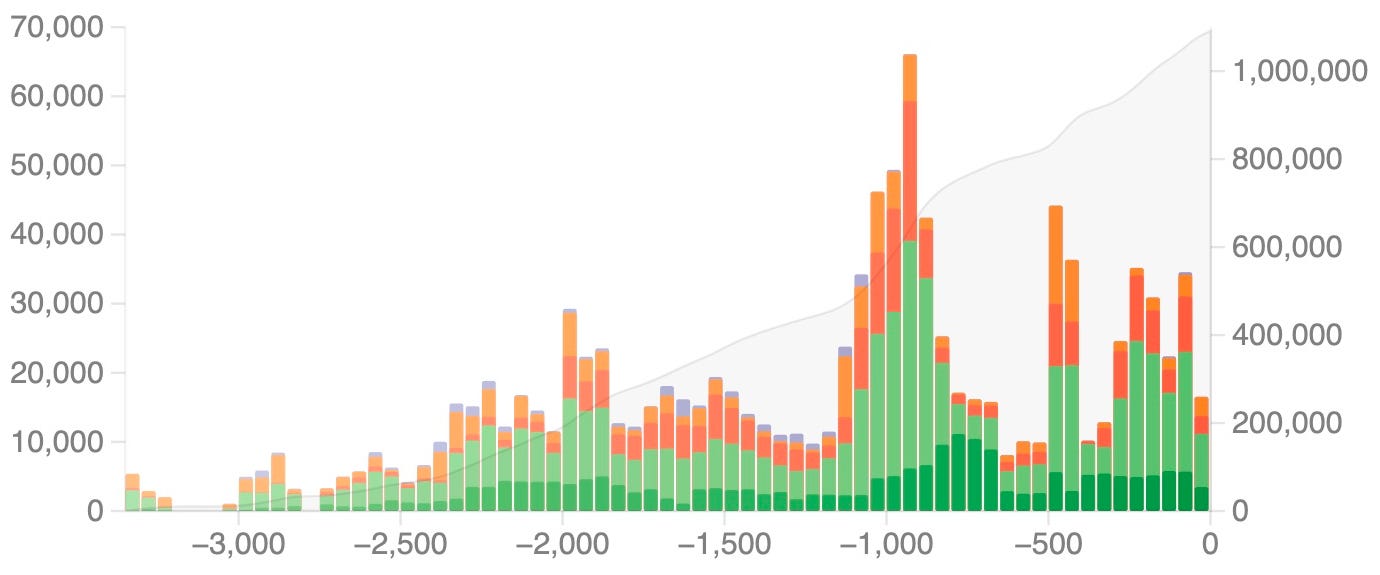
I gave a serious (or so I thought) try to the “I should become a polymath” idea twice in my life, once in my early 20s when I started college, then in my late 20s as a master’s student. Here is what I did each time:
Early 20s: start a few Coursera courses or textbooks every week, give up most fast, continue until the end for a minority of them.
Late 20s: log every interest of mine using org-mode, learn things Anki-first, become capable of fully building the theories mathematically.
Both times involved lots of time
Perusing curricula and syllabi2 for different fields,
Downloading and skimming books,
Actually reading while taking notes.
Those three activities were most of what I did during my early 20s attempt. LessWrong geniuses, polymaths like Piero Scaruffi3 and YouTube polyglots made a strong impression on me and were a source of inspiration.
To illustrate how chaotic my process was, at the time I first started learning Mandarin, I had been doing both French and Russian for 1-2 months. None of those really stuck; a few months later I had moved on to other interests. Similarly when I first touched Naive Set Theory, both Contemporary Political Philosophy and Principles of Economics were still fresh in my memory and I was deep into Psychology.
This was my obsession and my passion. I would skip my mechanical engineering classes4 and stay home going over books. This polymath project failed on its own terms, most importantly because that which took so much effort to acquire just kept evading me later. A few years went by and detailed mental models just became hm’s and vague recollections.
To give an example, before reading the political philosophy book my leanings were libertarian, but its arguments for Rawlsianism ended up persuading me to become more of a classical liberal. Read that closely: the arguments persuaded me. The arguments were made of cogs; when you made the cogs turn, classical liberalism being right was manufactured as their conclusion. But as time passed, the cogs started to vanish, and my coherent understanding gave place to an unjustified allegiance to classical liberalism. That sucks!
The first time I used Anki must have been to go through the SpoonFed Chinese deck to learn sentences. Using Anki to learn things other than languages, including STEM subjects, was on my radar, but felt ludicrous. Yes, flashcards aren’t enough for acquiring vocabulary, but going through them quickly was clearly still useful. Memorizing basic sentences on Duolingo had taken me from basically zero to being comfortable with simple conversations in French. Anki seemed exceptionally well-suited for this type of thing.
But STEM? It is supposed to be about problem solving, and you can’t practice that with flashcards, can you? Also Anki has a clunky interface, who could possibly understand those many windows? Another thing: manually turning your knowledge into dozens or thousands of active recall prompts is crazy, right? That would for sure take an absurd amount of work. Designing good questions is hard, and typing everything out, including equations, takes time.
A major push to make me an Anki-first learner was Michael Nielsen’s essay. After a while, creating cards became muscle memory. As I read a textbook, my eyes would quickly identify key definitions and facts. Those were obvious candidates for carding, and there was little uncertainty in how to do so. I would generally use clozes, like
{{c1::The Most Forbidden Technique}} := {{c2::training an AI using interpretability techniques}}
which came from the AI Safety Atlas. Left-hand side is a concept, right-hand side its definition.
Just memorizing basic facts made my life much easier as a student. The benefits compound: when those are readily retrievable, learning more advanced things becomes easier. But that is just a small part of the process I developed. Most of the time was spent following my curiosity. Specifically, I like playing the skeptic and questioning things. Often that just means questioning my own understanding, suspecting that my mental models are subtly inconsistent or wrong. A feeling of annoyance at lack of clarity often motivated my questions. I wrote those questions directly into Anki’s note editor, then as I learned their answers by thinking or Googling, I would fill them in (or just edit the question if it turned out to not make sense).
It turns out that STEM subjects do involve a lot of concepts, and understanding those concepts and how they connect is key. Anki can help with that. Even the skill of solving problems can benefit from spaced-repetition. You can get pretty far simply by practicing basic techniques enough times. As for Anki’s interface, yes it could be made more modern, but soon enough I became blind to its shortcomings. You just get used to stuff. Even typing equations ceased to be a pain once I started seeing it as an opportunity to get good at LaTeX.
Developing these Anki skills led me to want to learn many different things systematically once again. Recall that the biggest issue I had in my first period of intense independent studies had to do with memory; Anki promises to fix that. Studying something just to forget it later felt futile, so I had naturally abandoned the habit of starting new things all the time. Anki gave me permission to embrace the chaos again, to try out anything I wanted.
Mathematical logic was not important to me in any practical sense, but every few months a cool discussion of Gödel’s theorems or something like it would catch my attention. Why couldn’t I simply push my “learn logic” project forward a little each time that happened? Use that bit of motivation to study for a few hours. Yes, progress would be slow, but after enough such iterations, it should accumulate. Except that without Anki, touching a subject for a few hours every three or five months would never work, certainly not for me. At that frequency, those few hours would be enough to learn a few things but never master and soon forget them. With Anki though, those infrequent sessions could still build off each other. Problem solved, even low-priority stuff like mathematical logic could be systematically learned, even if only in slow-motion.
And you can take this much farther! Solving memory enables cool applications. If you think about it, there is nothing preventing you from having dozens of active learning projects with this method. Some you will touch more often than others, but you can still indulge your curiosity quite widely. To manage the chaos, I started writing detailed logs about what I wanted to learn. I also had notes about what material I covered in each study session, dependencies between projects, and detailed plans about how to get to where I wanted.
For a while, I had a script help me schedule my learning sessions; this is just another level of automation analogous to Anki itself. Anki schedules practice sessions, my script scheduled knowledge acquisition sessions. This approach was inspired by a technique Piotr Wozniak developed and which is available in SuperMemo, incremental reading5. It was super cool for a while! It did feel like I was making progress on many different interests. The script also introduced some randomness into my study time which made it interesting.
But going back a little, I said there is nothing preventing you from having dozens of active learning projects with my method, but that is false. Anki enables you to get quite chaotic, keeping many projects in parallel. But it also forces you to limit the chaos since you need to be committed to reviewing. You can’t keep the knowledge if you don’t pay the rent.
This points to a flaw with Anki: you have to make conscious decisions about what to add and what to keep. The modal card is supposed to take only a few seconds per review, and a few minutes over its lifetime. So even spending a few extra seconds per card during review deciding whether to keep it can have a large impact on your review time. More importantly, deciding how much of a priority something is can be cognitively taxing. Remember, convenience is the whole game here. You could always do spaced reps with just pen and paper. The advantage of using software comes entirely from offloading decisions to the system. Follow its rules, and you shall remember, that is the promise.
Your priorities change, your database of tens of thousands of cards stays the same. What got me in the end were changing priorities. I still cared about the stuff I had studied except that no I didn’t. At some point I started wanting to transition from being a student to actually doing stuff, and it became hard to consistently apply enough effort to keep moving the needle on my many different projects. And then Anki itself increasingly felt like a pointless chore. In the abstract, spending “just” 10-20 minutes to maintain knowledge I had laboriously worked to build could be seen as cheap. But the reality is that 10-20 minutes every day adds up, plus it is boring, and also it simply loses its efficacy. This last point is important and, to my knowledge, underdiscussed.
Once most cards for a given subject had multi-year intervals, Anki increasingly turned into a closed game. I was practicing the cards, not the subject. In theory I could pass every test 90% of the time; in reality my understanding felt increasingly fragmentary and incomplete. Ironically the same words could be applied to describe the feeling I had a few years after my first, Anki-free, period of intense studies. So did I gain nothing by using Anki? Is Anki ultimately not that useful for long-term retention? Well, I think it does help, except not in the way I had thought.
Most of the benefit I derive from Anki comes from the early period when intervals are small. The benefits compound, more so if I am reading the textbook and learning new things about the topic every day. Being prompted to actively recall concepts, then learning new concepts that build upon them, those are conducive not only to acquisition of the individual concepts, but also to something better. By practicing the stuff a lot, you start forming a high-resolution mental model of the subject. You understand the whole and also the parts.
As time goes on, the intervals grow to weeks and months. Here is where I would say the bulk of the value-added in terms of retention comes from. Without such practice, even those crisp mental models you formed through intense studies could degenerate depressingly fast. Anki significantly increases the lifetime of knowledge. And that has all sorts of secondary benefits.
But the crispness will decay. I once saw someone joking on reddit saying that “we all need to brush up linear algebra”. Anki can’t save you from that: use it or lose it. Or to be precise, you won’t lose it. Your linear algebra will still be there, but despite the reps you will still need to brush up. And this brings us to the contribution to long-term retention by Anki. You get to wait longer before needing to brush up, and brushing up will feel substantially easier. Your understanding can feel vague and diffuse, but the knowledge will be there to be reacquired.
I suspect retiring cards after a level of maturity is a generally good practice, and there are add-ons for that. Maybe I should try them, my own big suspension rounds were always manual (or, recently, AI-assisted) and at points when I felt crushed by a large amount of pointless reviews.
Anki is wonderful. Partly out of annoyance with its warts, and partly because I was sick and didn’t have much energy for it, last month I quit for a few weeks. I stopped adding cards with facts and definitions related to the projects I was working on, and that led to a lot of time wasted running in circles. Having the important stuff readily retrievable makes everything easier; it makes my ideas sharper. We should not lose sight of how great normal spaced-repetition software is. But better solutions should be possible. I am trying things, and I want to share more about that later.
At least 12% of which were from geography decks like Ultimate Geography and 47% of which were Mandarin
As well as guides like The Best Textbooks on Every Subject, Teach Yourself Logic and How To Become A Pure Mathematician.
I find it a little funny that alternative music is what led me to LessWrong. Luke Muehlhauser had great lists to go with Scaruffi’s.
To this day I find risible how little I learned from college, despite the fact that I was basically studying all the time.
My understanding is that what I did is significantly different from incremental reading.